
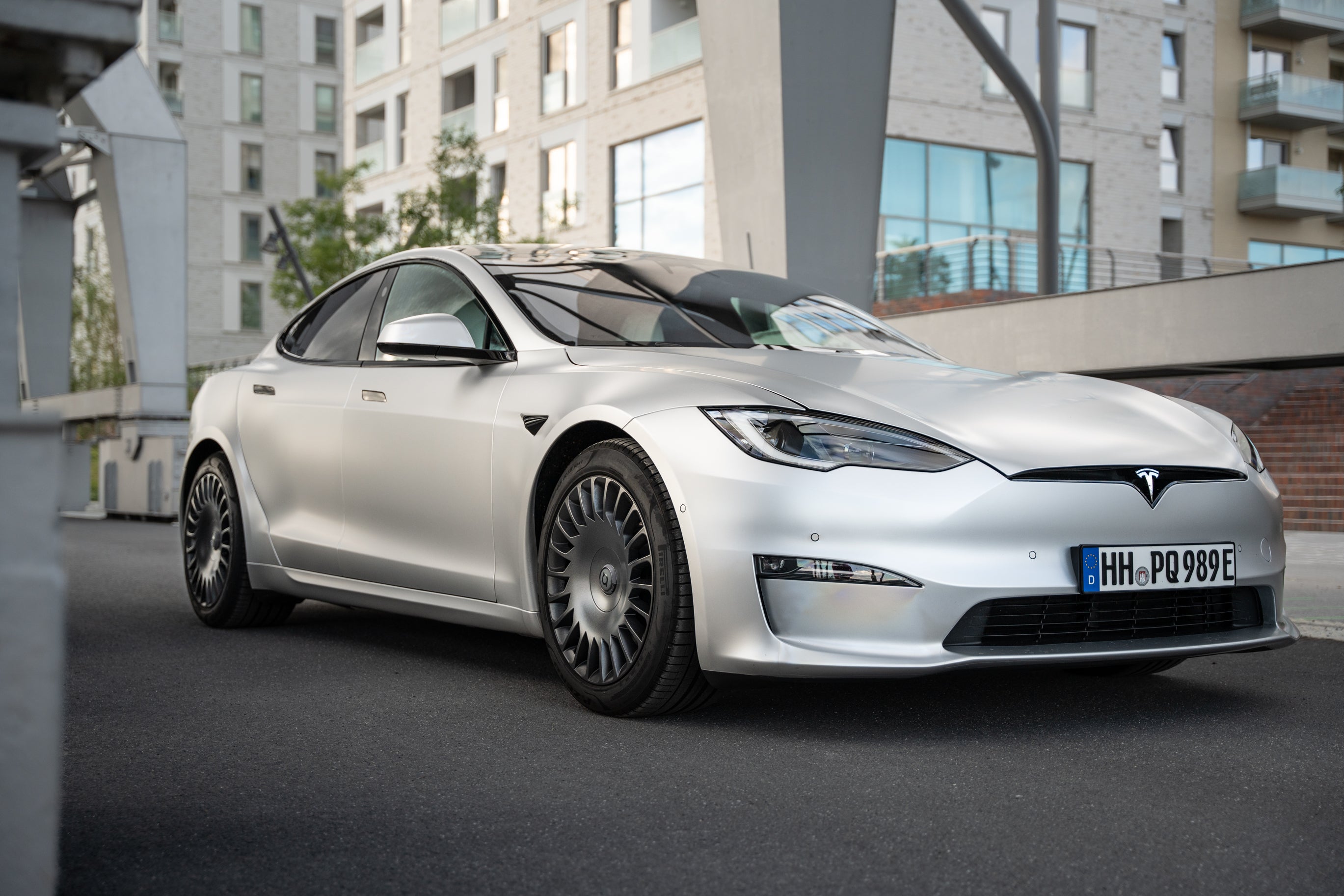


Elon Musk has confirmed that Tesla will soon significantly improve the Autopark system. The goal: Vehicles should park "essentially perfectly" in the future – a basic requirement for the planned introduction of fully automatic charging.
Limits of the current Autopark system
Currently, Autopark in Tesla vehicles is practical but still associated with limitations:
-
Vehicles can only park in reverse in parking spaces or parallel park.
-
Forward parking is not possible.
-
The system's speed is slower than a human's, which is particularly impractical at busy Superchargers.
-
The car often does not position itself precisely enough, so at older V2 and V3 Superchargers, the cable does not reach properly – especially a problem with the large Cybertruck.
Many owners therefore report a rather low success rate, especially at Supercharger locations where Autopark would actually be most useful.
Perfect Autopark as a basis for wireless charging
The further development is more than a comfort function – it is a central building block for Tesla's future strategy. Musk has repeatedly emphasized that charging should be fully automated. In the long term, Tesla is relying on inductive, wireless charging at Superchargers.
For this to work, the vehicle must be positioned over the charging plate with millimeter precision. Even the smallest deviations would affect the charging speed. An almost perfect Autopark is therefore not an option but a necessity to make the vision of hands-free charging a reality.
Connection to Robotaxi and Cybercab
The perfect Autopark also plays a key role in Tesla's Robotaxi program. The announced Cybercab is to be charged exclusively wirelessly. In addition to the planned expansion to other models like the Cybertruck, the technology will be crucial for the entire Tesla portfolio in the medium term.
Next steps: Autopark and Supercharger queue
Before wireless charging becomes a reality, Tesla first wants to solve the existing problems with Autopark. This also includes integration with the upcoming virtual Supercharger queue:
-
Vehicles could automatically wait in the queue.
-
As soon as a charging spot becomes available, the Tesla parks itself.
-
The driver only needs to connect the cable – until charging occurs entirely without manual intervention in the future.
Conclusion
Musk's announcement is more than a promise to dissatisfied users: The perfect Autopark is the key to Tesla's future plan with fully automatic charging and autonomous driving. For drivers, this initially means more comfort and reliability – in the long term, it will form the basis for a seamless Robotaxi and charging experience.

Hat dir unser Beitrag gefallen?
Wenn du bereits stolzer Tesla-Fahrer bist oder es zeitnah werden solltest, besuche unseren Onlineshop Shop4Tesla und sichere dir 10% Rabatt auf alle Produkte mit dem Rabattcode: NEWS4TESLA. In unserem umfangreichen Sortiment findest du eine Vielzahl an hochwertigen Tesla-Zubehörteilen für jedes Modell. Entdecke spannende Innovationen und Zubehör, die dein Tesla-Erlebnis noch besser machen - www.shop4tesla.com.